2. marts 2026
The energy in the room was unmistakable as more than 100 researchers from across Denmark gathered at the Danish Architecture Centre in Copenhagen on 25 February 2026, marking the first national conference on translational cancer research hosted by DCCC.
The ambition was clear: to strengthen the connection between basic and clinical cancer research, and to take the first concrete steps towards building a more integrated national research community. A key goal was to increase visibility across the many local translational cancer research environments in Denmark whilst creating new connections between them.
“We are both proud and delighted by the strong interest in the conference. It clearly demonstrates a long-standing need for a national forum where basic and clinical cancer research can come together and advance in tandem. For the continued development of our health care system, it is crucial that research advances and breakthroughs—whether emerging from the laboratory or through new medical and technological solutions — are effectively translated into clinical practice,” says Henrik Ditzel, Professor and Head of Research at Unit of Cancer Research, University of Southern Denmark and Department of Oncology, Odense University Hospital, and a member of the organising committee.
International perspectives and concrete paths to clinical application
The day opened with a keynote by Peter Jones, Distinguished Professor at the Van Andel Institute, and one of the world's leading authorities on epigenetics and cancer biology, who set the scene with a compelling talk on targeting DNA methylation in cancer. A vivid example of how fundamental biological discoveries can pave the way for new treatment strategies.
“We showed more than 40 years ago in tissue culture that Vitamin C could stop premalignant mouse cells from becoming cancer. About 35 years went by before we could see if this approach might work in humans. The key to translating the finding was teaming up with Professor Kirsten Grønbæk and her team of hematologists in Copenhagen to do a clinical trial, which has promising results. This just shows how important it is to communicate and interact between basic and clinical science, and that is precisely why meetings like this, bringing these fields together, are so important. We are now going back to our mouse cultures to see if we can figure out how it works” adds Peter Jones.
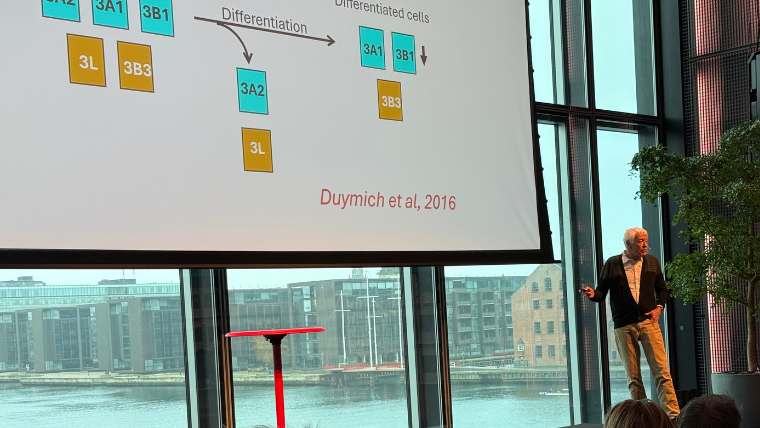
Peter Jones, Professor of the Van Andel Institute delivering the opening keynote on DNA methylation in cancer.
Throughout the day, six research pairs, each consisting of a basic and a clinical researcher, presented their collaborative work side by side, covering areas from epigenetics and rare cancers to renal cancer, mechanisms of drug resistance, biologically guided radiation therapy, and the translation of antibody-drug conjugates from discovery to early clinical trials. The format underlined the core message of the day: that the strongest science happens at the interface between the laboratory and the clinic.
"It has been inspiring to see how researchers and clinicians from across the country have seized the opportunity to meet, discuss, and explore new collaborations. We wanted to highlight the many strong research environments and bring them together within a shared national framework, and that has very much been achieved," says Kirsten Grønbæk, Professor, Director at the Danish Research Center for Precision Medicine in Blood Cancer, Rigshospitalet & Biotech Research and Innovation Centre (BRIC) and member of the organising committee.
A highlight of the afternoon was an inspiring talk by Kristian Helin, President and Chief Executive of the Institute of Cancer Research in London, who challenged the audience to reflect on whose vision should define the future of Danish cancer research, and what ambitions we dare to set. Additional international contributions included some very interesting insights into tumour evolution and early detection through spatial transcriptomics and whole genome sequencing in high-grade serous ovarian cancer, presented by Ingrid Hedenfalk, Professor from Lund University Cancer Center.
The international speakers provided valuable perspectives on how translational research is organised and strengthened at the highest level internationally.

International perspectives from Kristian Helin of the Institute of Cancer Research and Ingrid Hedenfalk of the Lund University Cancer Center, alongside collaborative research pair presentations.
Flash talks showcase the breadth of Danish translational research
The afternoon also featured a session of flash talks showcasing cutting-edge work spanning epigenetics, RNA biology, spatial transcriptomics, biomarkers, and novel treatment strategies — a testament to a thriving and diverse translational research community across Denmark.
The flash-talk format provided a dynamic and engaging insight into current research projects and showed how strong the field is while also demonstrating how complex knowledge can be communicated in just a few minutes.
The session flowed seamlessly, largely thanks to a team of highly skilled moderators who kept the proceedings precise, energetic, and engaging throughout.
A Strong Foundation for Future Collaboration
Throughout the day, basic and clinical researchers presented their work side by side. Questions crossed institutional boundaries. Contacts were exchanged. The format made visible what is too often invisible: that the distance between a laboratory discovery and a new treatment is not only scientific, it is also shaped by connection, communication, and collaboration.
"We have received an incredible number of positive responses, both about the academic level and about the value of having a dedicated national forum for translational cancer research. It is clear that there is both energy and potential for even more national collaboration across environments," says Signe Borgquist, Department Chair, Clinical Professor, Aarhus University Hospital and Aarhus University, and member of the organising committee.
More than just a one-day event, the conference has laid the cornerstone for a recurring platform that brings together researchers and clinicians from across Denmark – and marks an important first step towards DCCC’s ambition to strengthen the connection between basic and clinical cancer research, fostering new partnerships, and accelerating the translation of research breakthroughs into tangible benefits for cancer patients.